
Abu Dhabi–Baku Agreement: Strategic Signals for Investors
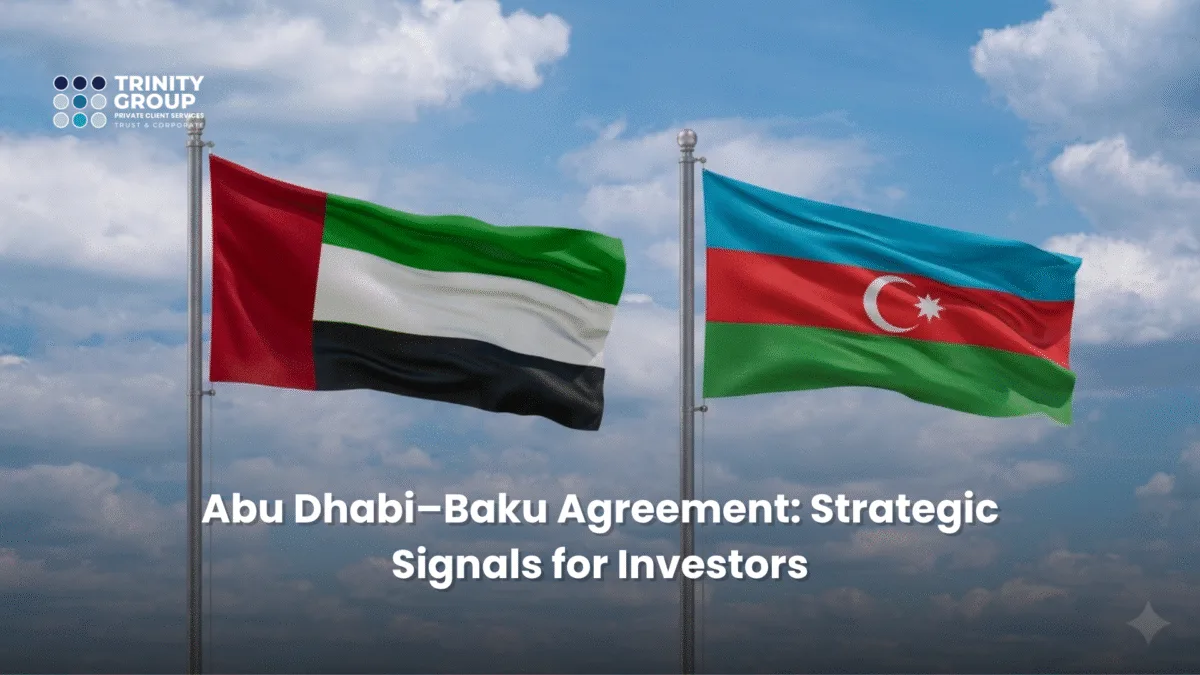
The recent Abu Dhabi–Baku cooperation agreement reflects a steadily maturing economic corridor between the United Arab Emirates and Azerbaijan — one that is becoming increasingly structured, institutionalised, and commercially relevant.
While the public focus centres on smart mobility and urban planning collaboration, the broader implication lies in deeper strategic alignment between two jurisdictions positioning themselves as regional gateways.
For internationally active businesses and investors, this development warrants careful consideration.
Strategic Context: Azerbaijan in the UAE’s Eurasian Outlook
Azerbaijan occupies a pivotal position along the Middle Corridor connecting Central Asia, the Caucasus, and Europe. Continued investment in ports, logistics hubs, and transport infrastructure has reinforced its importance within regional trade architecture.
For the UAE, strengthening ties with Azerbaijan supports wider objectives: expanding non-oil trade corridors, diversifying geopolitical partnerships, enhancing infrastructure collaboration, and reinforcing institutional coordination.
This latest framework signals a shift from diplomatic engagement to practical regulatory and operational alignment.
From Urban Cooperation to Commercial Implications
Urban cooperation agreements often serve as early platforms for broader economic engagement. Historically, such frameworks precede infrastructure partnerships, public–private investment activity, technology deployment, and professional advisory expansion.
Collaboration on mobility transformation and digital governance indicates a shared ambition to modernise urban ecosystems through integrated planning and technology — areas where UAE entities have developed recognised expertise.
For businesses, this may translate into opportunities across logistics, infrastructure, sustainable development, technology integration, and cross-border structuring.
Investment and Structuring Considerations
Economic relations between the UAE and Azerbaijan have already expanded across energy, tourism, and infrastructure sectors. Institutional cooperation strengthens confidence and enhances the commercial rationale for structured engagement.
This may include:
- UAE-based holding entities with Azerbaijani exposure
- Regional trading platforms linking Europe and the Gulf
- Investment vehicles targeting Caucasus infrastructure
- Coordinated treasury and financing functions
As global supply chains continue to diversify, Azerbaijan’s geographic positioning offers strategic value for UAE-based groups seeking access to Eurasian markets while maintaining regulatory stability.
The UAE as a Coordination Platform
For Azerbaijani businesses and investors, the UAE remains a stable and internationally recognised jurisdiction for regional coordination.
Its established mainland and free zone frameworks, extensive treaty network, mature banking infrastructure, and transparent corporate tax regime support holding structures, regional headquarters, and international trading entities.
Strengthened institutional alignment between the two jurisdictions enhances the long-term viability of such structures.
Governance and Long-Term Planning
Cross-border corridors are most effective when supported by disciplined structuring. Increasing global emphasis on transparency, economic substance, and compliance standards requires careful alignment across jurisdictions.
For businesses exploring UAE–Azerbaijan opportunities, early consideration of corporate classification, tax exposure, operational substance, and banking coordination is essential.
Trinity Group’s Perspective
At Trinity Group, we are observing growing strategic interest in Gulf–Eurasia corridors, including Azerbaijan.
Our advisory-led approach supports clients through:
- UAE mainland and free zone company formation
- Cross-border holding and investment structuring
- Corporate banking coordination
- Tax advisory and compliance alignment
- Accounting and ongoing regulatory oversight
- Asset protection and long-term planning
Where institutional cooperation strengthens, commercial structuring decisions often follow. Ensuring that legal form, operational substance, and regulatory expectations are aligned from the outset is fundamental to long-term resilience.
A Broader Direction of Economic Engagement
The Abu Dhabi–Baku agreement reflects the UAE’s continued expansion of structured economic partnerships beyond traditional markets.
For internationally active businesses, it signals that the Gulf–Eurasia corridor is becoming more predictable, more coordinated, and increasingly investable. The advantage lies in approaching this corridor with strategic clarity and professional oversight from the beginning.