
Dubai Attracts Global Millionaires as Major Wealth Transition Accelerates
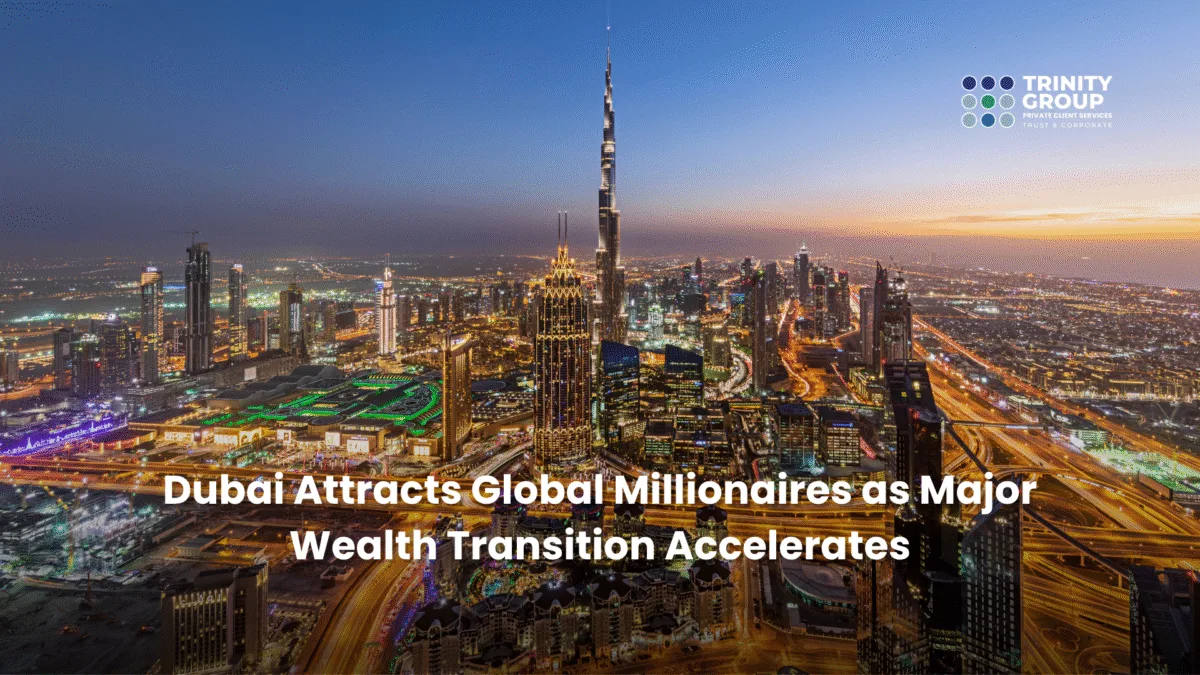
DIFC outlook highlights structural transformation in global wealth allocation
Dubai is reinforcing its position as a global centre for private capital, with approximately 9,800 millionaires relocating to the emirate in 2025 alone — the highest net inflow globally.
The figures form part of the Dubai International Financial Centre’s (DIFC) inaugural Future of Finance report titled Global Wealth Outlook: Rethinking Growth in a Changing World, which assesses how high-net-worth individuals are responding to volatility, regulatory divergence and generational wealth transitions.
At the heart of the report lies a significant long-term projection: an estimated $124 trillion wealth transfer by 2048, marking one of the largest generational reallocations of capital in modern history.
Jurisdiction as a Strategic Asset
The report indicates that geography is no longer a secondary consideration in wealth planning. Instead, jurisdictional stability, regulatory transparency and long-term predictability are becoming core portfolio factors.
In a period characterised by market volatility and political uncertainty, location risk is increasingly treated as a structural variable rather than a tactical decision.
Dubai’s positioning reflects this shift.
The Next Generation of Wealth Holders
By 2048, the projected $124 trillion intergenerational wealth transfer is expected to reshape investment behaviour and asset allocation models.
Two notable data points stand out:
- Women now represent more than 10% of global ultra-high-net-worth individuals (UHNWIs).
- Women are projected to inherit 95% of the $54 trillion in inter-spousal transfers over the coming decades.
The report suggests that future wealth strategies are increasingly balancing financial returns with family reputation, sustainability and social impact considerations.
DIFC’s Expanding Family Wealth Ecosystem
Dubai’s appeal to global private capital is reflected in the growth of DIFC’s wealth infrastructure.
Currently, DIFC hosts over 1,289 related entities, representing the largest wealth management ecosystem in the region.
The emirate’s designation of 2026 as the “Year of Family”, announced by President His Highness Sheikh Mohamed bin Zayed Al Nahyan, further reinforces the policy emphasis on intergenerational continuity and structured wealth governance.
To support this evolution, DIFC is expanding the DIFC Family Wealth Centre — a dedicated hub focused on multi-generational governance, succession planning and long-term wealth stewardship.
AI and the Evolution of Wealth Advisory
The report also highlights the transformation of wealth management itself.
Advisory models are increasingly combining:
- Private market deal structuring
- AI-enabled analytics
- Cross-border regulatory navigation
- Relationship-led wealth governance
Arif Amiri, CEO of DIFC Authority, observed that families are prioritising resilience and long-term sustainability amid regulatory fragmentation and generational transition.
He emphasised that Dubai’s globally integrated regulatory framework provides clarity and stability for private investors making long-term commitments.
What This Signals for Structuring Strategy
The projected $124 trillion wealth shift is not merely demographic — it is structural.
As capital moves across generations and jurisdictions, families and principals are reassessing:
- Holding structures
- Succession mechanisms
- Governance frameworks
- Cross-border regulatory exposure
- Banking architecture
Jurisdiction selection is increasingly aligned with political stability, legal transparency and institutional maturity.
Trinity Group’s Perspective
At Trinity Group, we are observing a clear shift in how internationally mobile families approach structuring in the UAE.
As Dubai strengthens its position as a global wealth destination, families typically require:
- Strategically structured UAE mainland or free zone entities
- Regulatory and compliance alignment across multiple jurisdictions
- Corporate banking coordination
- Accounting and reporting infrastructure
- Governance frameworks aligned with long-term succession objectives
The intersection of generational transfer, jurisdictional strategy and regulatory clarity is becoming central to capital preservation.
Looking Ahead
The anticipated $124 trillion wealth reallocation by 2048 represents a defining shift in global private capital.
Dubai’s ability to attract 9,800 millionaires in a single year signals that the emirate is increasingly viewed not simply as a regional financial centre, but as a jurisdictional anchor in an evolving wealth landscape.
For globally active families and advisors, the question is no longer whether capital will move — but how it will be structured.
Disciplined planning, regulatory alignment and institutional-grade structuring will remain critical as wealth transitions accelerate over the coming decades.