
Dubai’s Property Market Is Reinforcing Its Global Safe-Haven Status, And Investors Are Responding
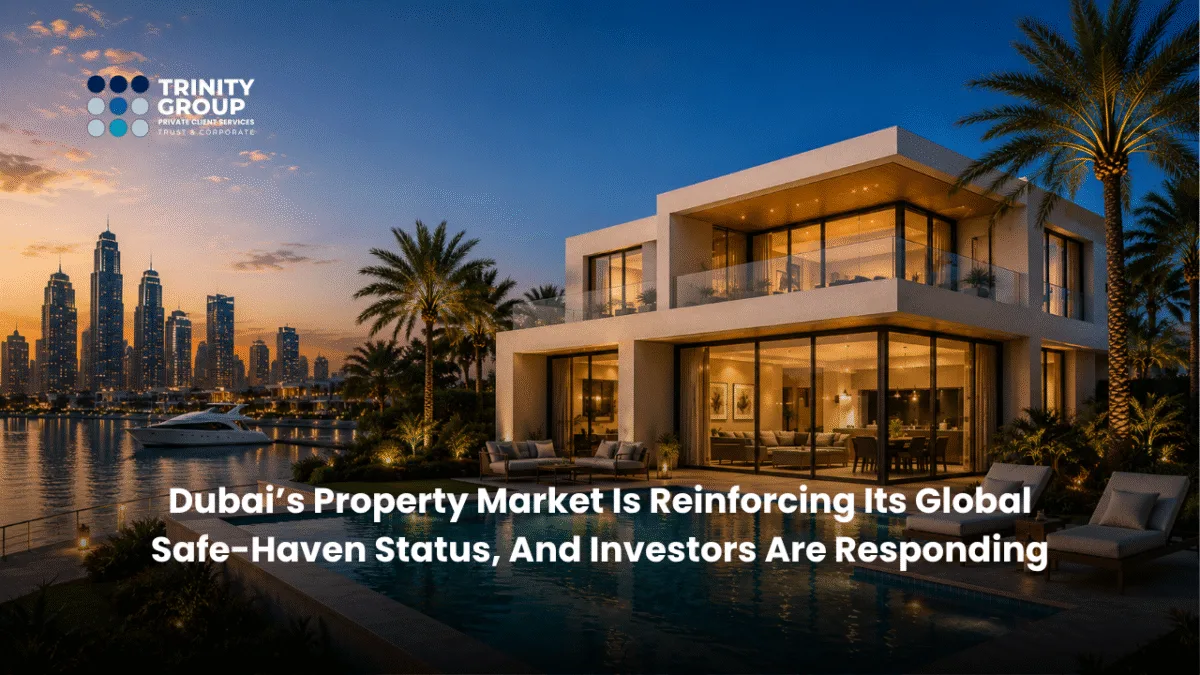
Dubai’s real estate sector continues to demonstrate an unusual combination of resilience, liquidity and international appeal at a time when many global markets are being shaped by geopolitical uncertainty, inflationary pressure and tighter capital conditions.
Recent reporting from regional and international publications highlights a clear trend: despite heightened tensions across the Middle East and broader investor caution globally, capital continues to flow into Dubai property, while major developers are posting strong financial results and transaction activity remains robust.
This is not simply a short-term reaction to regional instability. It reflects a deeper structural shift in how global investors, entrepreneurs and family offices increasingly view the UAE, not merely as a tax-efficient jurisdiction, but as a long-term base for wealth preservation, international business operations and strategic residency planning.
According to recent coverage by Arab News, Dubai and Abu Dhabi’s office and residential markets have remained notably resilient despite regional conflict concerns, supported by constrained supply, international demand and continued business migration into the UAE. At the same time, reporting by The Wall Street Journal noted that major developer Emaar recorded a significant rise in quarterly profits, underlining continued confidence in Dubai’s development pipeline and buyer demand.
Meanwhile, analysis from Khaleej Times emphasised that investors are increasingly prioritising stability, capital protection and globally connected jurisdictions, all areas where Dubai continues to strengthen its position.
Why Dubai Is Attracting Global Capital During Uncertain Times
Historically, periods of geopolitical or economic uncertainty tend to trigger capital flight into established “safe haven” destinations. Traditionally, this benefited markets such as London, Singapore or Switzerland. Increasingly, Dubai is joining that conversation.
Several factors are driving this transition.
1. Political Stability And Economic Pragmatism
The UAE has spent the past decade positioning itself as one of the region’s most commercially stable environments. Regulatory modernisation, long-term visa reforms, improved corporate governance standards and investor-friendly policies have significantly enhanced international confidence.
For international entrepreneurs and HNWIs, predictability matters as much as returns. The UAE’s ability to maintain economic momentum while neighbouring regions experience disruption has become a major competitive advantage.
2. Continued Population And Business Migration
Dubai’s growth is no longer driven solely by tourism or speculative investment. The emirate is benefiting from sustained inward migration of:
- International entrepreneurs
- Remote business owners
- Wealthy expatriate families
- Investment professionals
- Tech founders and digital businesses
- Family offices relocating regional operations
This migration trend creates genuine end-user demand across residential, commercial and mixed-use sectors.
The office market is particularly noteworthy. Prime commercial space in Dubai and Abu Dhabi remains constrained, while demand from multinational firms and regional headquarters continues to rise. This creates opportunities not only for property investors, but also for businesses entering the UAE market.
3. The UAE’s Growing Role In Global Wealth Structuring
For many international investors, UAE property acquisition is now part of a broader wealth and residency strategy rather than a standalone investment decision.
Property ownership increasingly intersects with:
- UAE residency eligibility
- International tax planning
- Asset diversification
- Succession structuring
- Family office establishment
- Regional operating company setup
This reflects a more sophisticated investor profile entering the market compared with previous property cycles.
What This Means For Entrepreneurs And International Businesses
The implications extend well beyond real estate.
As more capital and talent relocate into the UAE, demand rises across multiple sectors including:
- Professional services
- Financial advisory
- Healthcare
- Technology
- Logistics
- Hospitality
- Education
- Private wealth management
For entrepreneurs, this creates a favourable environment for launching or expanding businesses that service an increasingly affluent and internationally connected population.
Equally important is the UAE’s role as a regional gateway. Many companies establishing operations in Dubai are using the emirate as a base for wider GCC, African and Asian market access.
This is particularly attractive for businesses seeking:
- Currency stability
- Competitive taxation
- International banking access
- Strong aviation connectivity
- Efficient corporate setup infrastructure
- Legal certainty and investor protection
In practice, many overseas founders entering the UAE today are approaching market entry with far greater strategic sophistication than in previous years. Rather than simply opening a company, they are considering long-term residency, holding structures, operational substance requirements and cross-border tax exposure from the outset.
The Shift Towards Structured Wealth And Corporate Planning
One of the most significant developments emerging from Dubai’s growth cycle is the increasing institutionalisation of private wealth within the UAE.
Family offices, holding entities and private investment structures are becoming more common as international families consolidate regional assets under UAE-based frameworks.
This has increased demand for:
- Corporate structuring advisory
- DIFC and ADGM entity formation
- Multi-jurisdictional compliance support
- Banking coordination
- Asset protection planning
- Succession and governance advisory
For investors relocating substantial capital into the UAE, operational setup is no longer viewed as an administrative exercise. It has become part of broader wealth preservation and international mobility planning.
This is where experienced advisory firms play an increasingly strategic role.
Why Strategic Execution Matters More Than Ever
While Dubai remains highly accessible for international investors, the regulatory environment is also becoming more sophisticated.
Economic substance rules, corporate tax implementation, AML compliance obligations and international reporting standards mean that businesses entering the UAE need properly structured foundations from day one.
Investors who move early, but move strategically, are typically best positioned to benefit from the current market cycle.
For many entrepreneurs and international families, this means working with advisors capable of coordinating multiple areas simultaneously, including:
- Company formation
- UAE residency processing
- Corporate banking assistance
- Tax and compliance structuring
- Real estate holding structures
- Family office support
- Ongoing PRO and government liaison services
A Market Entering A More Mature Phase
Dubai’s property market today differs substantially from previous growth cycles.
The current expansion is being supported by:
- Long-term residency reform
- Sustained foreign direct investment
- Corporate migration
- Infrastructure development
- Institutional capital participation
- Global wealth relocation trends
This creates a more durable foundation than purely speculative demand.
Naturally, certain segments may experience periods of moderation as pricing adjusts and investor sentiment evolves. However, the broader direction of travel remains clear: the UAE is continuing to strengthen its position as a global centre for capital, entrepreneurship and internationally mobile wealth.
For investors and business owners considering the region, the key opportunity may no longer be whether to enter the UAE market, but how to structure that move intelligently for long-term advantage.
How Trinity Group Supports Investors And Businesses Entering The UAE
For investors, entrepreneurs and family offices, entering the UAE market successfully requires more than identifying an opportunity. It requires the right structure, regulatory clarity and a practical route to execution.
Trinity Group supports clients across the full business and investment lifecycle, from company formation and UAE residency solutions to corporate structuring, banking assistance, tax and compliance advisory, PRO services and family office support.
This integrated approach is particularly valuable in a market where property ownership, business expansion, residency planning and wealth structuring often overlap. By aligning commercial objectives with the correct legal and operational framework, Trinity Group helps clients establish a stronger, more resilient presence in the UAE and wider GCC.