
UAE Infrastructure Investment Signals a Shift Towards Execution-Driven Growth
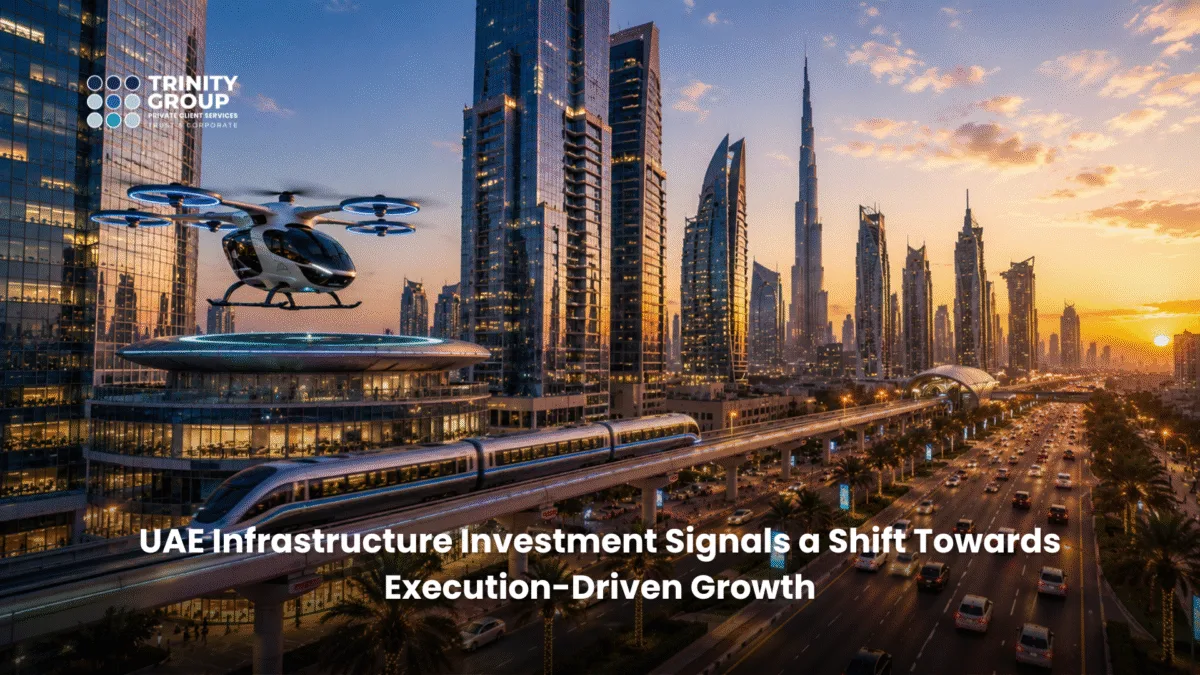
The UAE’s continued investment in national infrastructure reflects a shift from planning to execution, with projects now being delivered at scale across transport, utilities, and urban development. This trend is consistent with recent regional economic reporting.
For international businesses, this is less about headline growth and more about what sits beneath it: a more operationally efficient environment in which to build and manage regional activity.
From strategy to delivery
Infrastructure has long been part of the UAE’s economic model, but the current phase is characterised by pace and implementation. Projects are being advanced across multiple sectors simultaneously, reinforcing a more integrated national framework.
For businesses, this has practical implications:
- Reduced operational bottlenecks
- Greater consistency in service delivery
- Improved reliability across key systems
This type of environment tends to support businesses that require stability at an operational level, particularly those coordinating activity across several markets.
Integration across sectors
A notable feature of current development is how different sectors are being aligned. Energy, water, transport, and urban planning are being developed in parallel, rather than in isolation.
For international organisations, this creates a more cohesive operating landscape. It allows for:
- Better alignment between logistics and infrastructure
- More predictable cost and service structures
- Easier long-term operational planning
Rather than responding to isolated improvements, businesses are entering a system that is being built to function as a whole.
Infrastructure and market accessibility
As infrastructure improves, so too does access to the market. Enhanced transport networks, expanded urban areas, and upgraded utilities make it easier for businesses to establish and scale operations.
This is particularly relevant for:
- Companies establishing regional distribution models
- Service providers reliant on consistent infrastructure
- Businesses requiring proximity to developing commercial zones
In many cases, infrastructure readiness becomes a deciding factor when selecting a regional base.
Urban expansion and commercial alignment
Urban development continues to play a central role in shaping economic activity. New and expanding districts are not only residential but increasingly commercial, creating additional points of entry for businesses.
For international firms, this supports:
- Expansion into emerging business areas
- Access to growing customer bases
- Alignment with long-term population and economic trends
This reinforces the UAE’s position as a market where growth is planned and supported, rather than reactive.
Structuring within a maturing environment
As the UAE’s infrastructure becomes more advanced, the importance of proper structuring becomes more pronounced. A well-developed environment reduces barriers, but it also raises expectations around how businesses are set up and operated.
Typical considerations include:
- Establishing appropriate corporate structures for regional activity
- Ensuring banking access aligns with operational needs
- Maintaining compliance across jurisdictions
These elements become increasingly important as businesses scale within the region.
Trinity Group’s perspective
At Trinity Group, we see infrastructure development as a practical enabler of long-term business operations, rather than simply a growth indicator.
For clients considering entry into the UAE, expansion, or restructuring, the current environment supports more efficient execution—but also requires careful planning.
Our work focuses on company formation across UAE jurisdictions, corporate banking support, accounting and tax advisory, and longer-term structuring.
The aim is to help clients build operational frameworks that function effectively within a market that is becoming more connected, integrated, and execution-driven.